Archive for the ‘Kansas’ Category
Wordless Wednesday – My Dad, Harold “Jiggs” Stocking, Sr, and Me
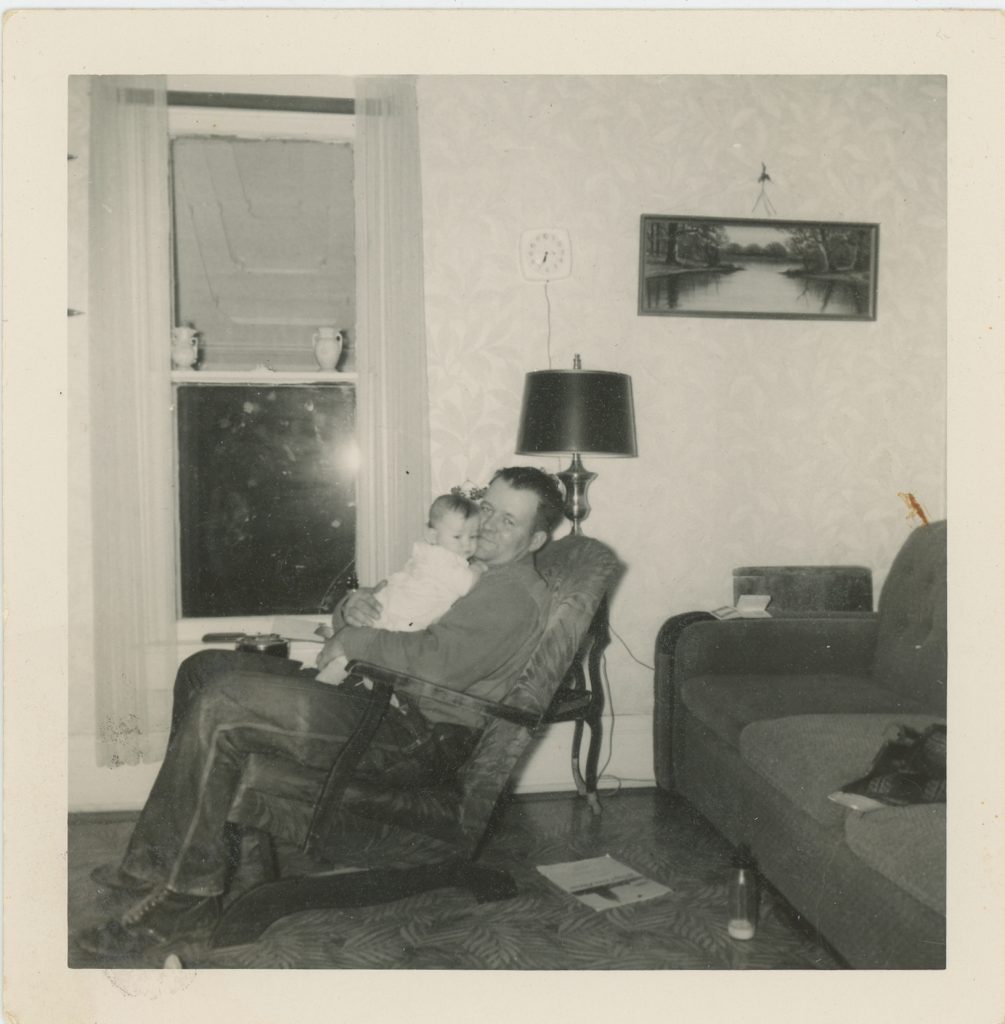
Harold “Jiggs” Stocking and baby daughter, Sherry Lynn
Related Items:
 Posted in Kansas, Sherry's Family Tree, Stocking Family Genealogy, Wordless Wednesday |
  Tags: Harold Stocking |
  No Comments »
Day Five – 365 Days of Memories – Bartlett Arboretum and Best Friends Forever
Bartlett Arboretum and Best Friends Forever
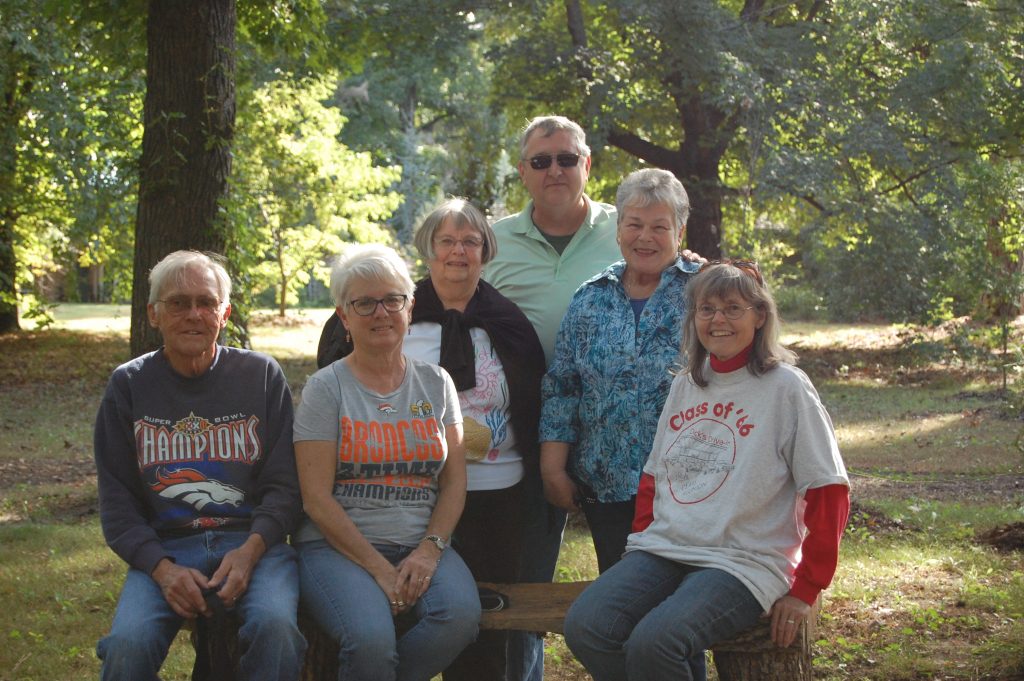
Best Friends Forever Visit the Bartlett Arboretum in Belle Plaine Kansas
Sometimes, when you take a memory out and look at it again, and again, it gets better and better. This time we four girls had together again after not being together for nearly twenty years, was just such a memory.
The day before we met up at our 50th Wellington High School Class of 66 Reunion. We shared hugs, and memories, photos of our kids and grandkids and got caught up.
We made plans the next day to meet and take in the beautiful Bartlett Arboretum and enjoy the lovely together before BFF Nancy and her hubby headed back home.
The day was one of those lovely Kansas Indian summer days in October that make you glad to live in Kansas. The sunlight was golden, the grasses still green and the leaves just beginning to turn gold.
It was a beautiful day, and a beautiful memory.
Posted in 365 Days of Memories, Journaling, Kansas, Kansas Towns, Memoir Writing, My Memories |
Tags: Bartlett Arboretum, Belle Plaine, Kansas |
2 Comments »
Amanuensis Monday – R. Stocking Injured in Farm Accident
Wellington Daily News
8 July 1921
Pg 1
R. STOCKING INJURED
I love doing newspaper research, especially when I find ‘buried treasure’ about my Great-Grandfather, Roderick Remine Stocking!
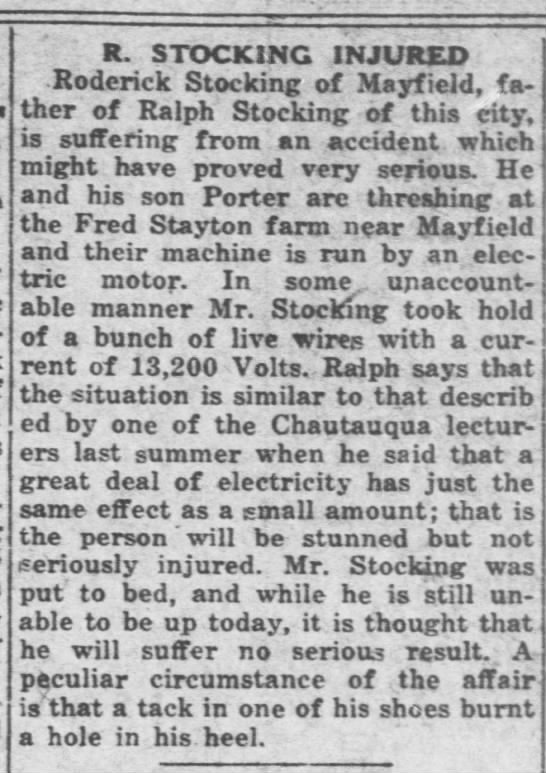
Roderick Stocking – Wellington Daily News
R. STOCKING INJURED (transcription)
Wellington Daily News
8 July 1921
Pg 1
Roderick Stocking of Mayfield, father of Ralph Stocking of this city, is suffering from an accident which might havev proved very serious. He and his son Porter are threshing at the Fred Stayton farm near Mayfield and their machine is run by an electric motor. In some unaccountable manner Mr. Stocking took hold of a bunch of live wires with a current of 13,200 Volts. Ralph says that the situation is similar to that described by one of the Chautauqua lecturers last summer when he said that a great deal of electricity has just the same effect as a small amount; that is the person will be stunned but not seriously injured. Mr. Stocking was put to bed, and while he is still unable to be up today, it is thought that he will suffer no serious result. A peculiar circumstance of the affair is that a tack in one of his shoes burnt a hole in his heel.
Live in Kansas? Have a Kansas Driver’s License?
If so, you can research (most) Kansas newspapers for FREE!!!
Thanks to the Kansas State Historical Society, Kansan’s can access most of the Kansas newspapers offered on Newspapers.com just by going to the Kansas State Historical Society website, click on “Research”,, then click on “Digital Newspapers” in the dropdown box. Then scroll down on the page till you see a box like the one here that says: “Verify Your Driver’s License.”

Verification Form for Digital Newspaper Access.
I am so glad that my Great-Grandfather was not killed in this incident. He lived to be almost 98 years old, and I remember seeing him 3 different times, even though I was 2 1/2 when he passed away. He was a tall, handsome gentleman and I guess what I remember most is how tall he was and how white his hair was!
Posted in Amanuensis Monday, Free Stuff, Kansas, Mayfield, Newspapers, Stocking Family Genealogy, Sumner County |
Tags: Fred Stayton Farm, Kansas, Mayfield, Roderick Remine Stocking |
3 Comments »
Amanuensis Monday – Roderick Remine Stocking in the 1883 Historical Atlas of Sumner County, Kansas
When you’re hunting for information about your family, and especially if you are trying to find glimpses into their lives and create a word picture for your family, you want to look every place you can think of, so checking old atlases can add more information to your family tree.
The 1883 Historical Atlas of Sumner County, Kansas shared information about my Great-grandfather, Roderick Remine Stocking.
Some of it was information that I might not have found otherwise.
According to this Atlas (and not all have this information), my great-grandparents came from Michigan, and settled on their farm in 1878 where they farmed and raised livestock.
They lived near Mayfield, Kansas, in the NE 1/4 Section 13-32-3W. From other sources, I know that they homesteaded that quarter section and raised their family there.
Their son, Roderick Porter, raised their family there until he was killed in a farm accident, and then the family moved to the small town of Mayfield.
See excerpts from the atlas below:
Historical Atlas of Sumner County, Kansas,
Compiled – Drawn – Published from Personal Examinations and Surveys;
John P Edwards,
No 31 South 6th Street, Philadelphia, and Quincy, Illinois, 1883,
Engraved by A. H. Mueller, 530 Locust St., Philadelphia, PA, Printed by F. Bourquin,
31 S. 6th St.,
Philadelphia, PA
List of Patrons – p. 14
Name: Stocking, R. R.
Post Office: Mayfield, KS
Section: 13-32-3W
Business: Farmer and Stock Raiser
Nativity: Michigan
Settlement in County: 1878
p. 67
R. R. Stocking
Township 32 South Range 3 West
NE 1/4 13-32-3W
R. R.Stocking
Oh, and don’t forget to add this information into your family tree program (if you use one) and be sure and cite your sources so you know where you found it!
Elizabeth Shown Mills has written the definitive source for citing your resources, and the following links to her book and “Cheat Sheet” can help you cite your sources correctly :
“Evidence Explained: History Sources from Artifacts to Cyberspace 3rd Edition Revised” by Elizabeth Shown Mills
“QuickSheet: Citing Ancestry Databases & Images Evidence Style 2nd Edition” by Elizabeth Shown Mills
Disclosure: Some of the links included in this blog post may be affiliate links. This means that I receive a small commission for recommending this product.
This does not increase the price that you pay, and it helps support this genealogy blog.
I do not promote products that I do not use or do not believe in. However, it is always best to do your own research on products to make certain that they are a good fit for you and your family.
Merry Christmas! “Baby, It’s Cold Outside” with Jase and Missy
I hope you all have a Very Merry Christmas!
Thanks to Footnote Maven of http://www.footnotemaven.com/, Facebook page: https://www.facebook.com/footnoteMaven?fref=photo for her Christmas Carol blogging challenge! I have many, many favorite Christmas carols, and listening to all of them is a favorite part of Christmas for me. Most all of the time, I love the old favorites by the original artists, but I add new favorites as they come along.
Two years ago, I added “Baby, It’s Cold Outside” by Kansas girl Martina McBride and Dean Martin to a favorite’s list on my iPod! (And just so you know, my hubby got to meet her when she was still singing with her parents in different gigs around Kansas!)
He had truck trouble, and Martina’s folks were on their way to a gig and they picked him up and took him into town! She was a beautiful young lady (still is), and he came home with stars in his eyes!
Here are photos and their version of this Christmas classic
And last year, I added a new couple, Missy and Jase Robertson, singing “Baby, It’s Cold Outside” to my iPod’s favorites’ list. Missy has a lovely voice, and together they do such a cute job of singing this Christmas favorite.
And as for WHY is it one of my Christmas favorites. Here my “why.”
My Mom and Dad got up at five a.m. every morning, EVERY morning, cold, rain, snow, sleet, ice, didn’t matter, to milk the dairy cows. After they finished milking, Dad went out in the pasture to feed the cows, and Mom came in the house to start breakfast. (And wake me up if I wasn’t already.)
I have this wonderful memory of my dad coming in from a cold, snowy, early winter morning after feeding the cattle, all bundled up in overalls and a heavy flannel-lined coat, his face red from the cold, and that twinkle in his eye that was always there when he looked at my Mom, and he would sing “Baby, it’s Cold Outside” as he snuggled up to her, nuzzled her neck and gave her a chilly hug and kiss. And there was always laughter between them when he did that, and usually a few more kisses.
My dad died when I was not quite 13, and I am thankful for such a special memory, and the love that my parents had for each other and for me, and that still brings a smile to my face.
And as I sit here, playing these two songs, my mom, age nearly 103, has a big smile on her face, and she is singing along!
Thank God for the memories!
Carnival of Genealogy – Our Family Business Was a Wheat and Dairy Farm
My first thought when I read the Carnival of Genealogy Challenge for August was “we didn’t have a family business, we had a farm…”
And then I re-thought, realizing that a farm always was (and still is, no matter the size) a business also, though some might say that farming is more of a calling than a career, and for those of us who grew up on a farm, it’s more a part of our hearts than most brick or mortar businesses could ever be.
One of the sayings that I grew up hearing was “You can take the boy off the farm but you can’t take the farm out of the boy.” (Same goes for many of us farm girls, too!)
When my oldest brother was just a toddler, our folks bought the farm where dad grew up with his seven (living) brothers and sisters, and dad’s parent’s, Elmer and Maud (McGinnis) Stocking. My grandparents moved to the nearby town of Mayfield, Kansas with their youngest children and my grandfather Elmer continued his work as a mail carrier until his untimely early death from a heart attack.
Mom, Dad, and my brother Fred moved back to the Mayfield area from Arkansas City (“Ark City”) after they purchased the farm. All of this happened before I was born, or as my brother Harold, Jr. “Fred” would say “before you were even a twinkle in Dad’s eye.”
Farmers then, and farmers now, wear many hats. They must be amateur weathermen/women, watching the weather with an eye to scheduling their work. Their planning, planting, fertilizing, field work, harvesting, and even praying for rain circles around what the farm land needs and when it needs it.
Farmers also need to be bookkeepers, grain marketers, have the ability to supervise their family as workers, as well hired hands if they have some, and during the summer, they often have to put in 60 to 80 hour weeks as well. It wasn’t just sun up till sun down at our farm, it was before the sun came up till the job got done, especially during harvest.
I have always felt that I was one of the luckiest kids in the world, growing up on my folk’s wheat and dairy farm, with 160 acres running room for a back yard! I grew up collecting tadpoles from the buffalo wallows in the pasture (yes, I said buffalo wallows!), chasing crawdads along the creek, roping calves I wasn’t supposed to, and dodging cow pies in the pasture while playing cowboys and Indians, or Yankees and Confederate soldiers with my nephews, who were not much younger than I was.
I also learned to drive a tractor, an old blue Chevy farm truck with a stick shift that my mom nicknamed “WobbleKnees,” and milk a cow by hand as well as with a milking machine.
I was responsible for watering the chickens, gathering the eggs, spoiling our purebred collie puppies and making sure the cats and dogs had food and water.
I loved helping feed the baby calves, and always, always fell in love with one or two each year, wishing they could be my very own pet. I learned to back up straight (after I learned to drive a stick) by backing several hundred feet along a lane, and dumping a half-full milk can of water (about 70 pounds if they were full!) into the calves’ water tank to make sure they had enough water.
I helped hoe the garden, and helped preserve its bounty, enjoying the fresh tasting frozen sweet corn and the better than store-bought canned green beans all winter.
And, lucky me, with my work-at-home folks, I usually either had both my parents home with me, or I was in the field where they were working!
I loved growing up on the farm!
Posted in Carnival of Genealogy, Childhood Memories, Farm Life, Kansas, Mayfield, Stocking Family Genealogy |
Tags: Carnival of Genealog, Childhoo |
17 Comments »
Finding Your Family in Old Newspapers
by Sherry Stocking Kline
19 May 2011
I just finished reading a great post “Beyond the Obituary: Researching Your Family Tree in Newspapers” on the Legacy Family Tree’s website. It gives several excellent reasons for checking newspapers for your family, shares the different information you may be lucky enough to find, and showcases the ease of searching Genealogy Bank’s digitized and indexed records as well.
Many times I’ve bemoaned the fact that my ancestors lived in tiny little rural towns that Genealogy Bank doesn’t have in their collection. (I’m crossing my fingers that they will be added to the Genealogy Bank collection soon!)
Many of my ancestors lived or spent some time here as farmers, ranchers, and teachers in rural Sumner County, Kansas.
So first I determined the town(s) that my ancestors lived near. Many of these small rural towns in the area where my ancestors lived are about five miles apart. For instance, Milan and Mayfield.
So my next stop was to go to the Kansas State Historical Society website and search through their newspaper microfilm lists to see what newspapers I might be able to research.
Many times those small town happenings were included in both small-town newspapers as well as the larger newspaper(s) in Wellington, Kansas. At some periods of time, I found anywhere from 3 to 6 newspapers that might have my ancestor’s information.
When I typed the name “Mayfield” into the KSHS newspaper database I found the following:
| Mayfield Voice | 3/16/1894–2/28/1895 | Mayfield | Sumner | KS | H 1639 |
For a very short time, my tiny little town had its own newspaper!
Woo Hoo! Better and better, my Stocking ancestors lived in rural Mayfield for approximately twenty years at that point, and even better than that, this microfilm is available locally at the Sumner County Historical and Genealogical Society Research Center (open Tuesdays from 10 to 4, closed for lunch or other times by appointment) and the Wellington Public Library.
Next, I typed in the name of Milan, and found the following results:
| Title | Dates | Published in | County | State | Reel Number |
|---|---|---|---|---|---|
| Milan Herald | 9/1899–6/1900 | Milan | Sumner | KS | M 890 |
| Milan Herald | 9/1899–6/1900 | Milan | Sumner | KS | M 1488 |
| Milan Mirror | 1/18/1923–3/29/1923 | Milan | Sumner | KS | M 886 |
| Milan News | 1/19/1911–10/31/1912 | Milan | Sumner | KS | M 887 |
| Milan News | 11/7/1912–6/25/1914 | Milan | Sumner | KS | M 888 |
| Milan News | 7/2/1914–12/30/1915 | Milan | Sumner | KS | M 889 |
| Milan News | 1/6/1916–2/7/1918 | Milan | Sumner | KS | M 890 |
| Milan Press | 1/28/1892–6/27/1895 | Milan | Sumner | KS | M 891 |
| Milan Press | 7/4/1895–6/10/1899 | Milan | Sumner | KS | M 892 |
Wow! Over the years, Milan had four different newspapers!
While both my ancestors and my husband’s ancestors settled there before these newspapers came into being, it’s still a good way to locate many of their doings, their family get-togethers, and in some cases even the fact that they traveled with friends by train into Wellington fifteen miles away to shop for the day.
I believe that the Kansas State Historical Society sells these microfilms or loans the microfilm out to some libraries, http://www.kshs.org. But not all libraries have the capability (or perhaps it is funding) to to do this interlibrary loan.
I know this post may help Kansas researchers locate the newspapers they need to search for family info, and I hope that this post will help others looking for their family in other states.
Without the indexing, it takes a lot of time to hunt through microfilm after microfilm, but the good news is that here in rural Kansas, many of my ancestor’s events, and not just their birth and death announcements, but also when they traveled, where they traveled, how they traveled, and even who they may have had for Sunday dinner may be included in those small-town local newspapers columns.
Many thanks to Taneya who left a comment on this blog post, and a link to a great resource to help find other newspaper microfilms!
You may also wish to check the Library of Congress’ Chronicling America site for a directory of newspaper microfilm holdings across the country if you need to ever expand beyond Kansas: http://chroniclingamerica.loc.gov/
Saturday Night Genealogy Fun!
by Sherry Stocking Kline
10 April 2010
Here is this week’s Saturday Night Genealogy Fun Challenge from Randy Seaver!
Your mission, should you decide to accept it, is to:
1) Tell us: Which ancestor or relative do you readily identify with? Which one do you admire? Which one are you most like, or wish that you were most like? Which one would you really like to sit down and have a heart-to-heart conversation with?
2) Write your response in a blog post on your own blog, in a Facebook note or response to this post, or in a comment on this post.
Oh my, which ancestor or relative do I most identify with? I think my ancestors, especially the women, were brave and courageous, so in some ways I wish I were more like them. My great-grandmother Frances Hitchcock Stocking picked up her life, packed up their belongings, and followed the man she loved, Roderick Remine Stocking, here to Kansas, a flat prairie with tall grass and no trees for firewood (read they used buffalo chips to heat their homestead with) or they drove their wagon about 15 miles south into Oklahoma’s Indian Territory (which was illegal, mind you) to pick up firewood. They also lived within a few miles of the Chisholm Trail, and those who still traveled up and down it, even after the cattle drives ended.
And then there is my other great-grandmother on my mother’s side, Salinda Rose Breneman, who lived out on the prairie in Nebraska, where Indians might (and did) poke their heads in the window wanting food. And Indians wouldn’t have been their only danger. They would have lived in fear of prairie fires as well as rattle snakes, and her children, even at a young age, were sent out on horseback, sometimes with their lunch in a pail to herd the cattle, often being out of site of the homestead for the whole day.
Could I do what they did? I don’t think so.
Who would I most want to sit down with? My great-great grandmother, Elizabeth Laird Jones Crabb!
I would ask her what her first husband’s name was and thereby break down that brick wall! I would learn first-hand from her what her husband died from (or if they were divorced!) and I would ask her what brought them here to Kansas, and did they miss their home state of Kentucky and their daughter who stayed there?
And maybe I would just ask them how they ‘managed?’ How did they cope with the hardships, water that came from a well and wasn’t the clear liquid that we’re used to today, growing and canning and preserving much of their food, and sewing many of their clothes?
And particularly, where did they find the courage to go on when they had to bury their young children because their lives were cut short from disease and farm accidents?
So many questions that I would ask these courageous women!
Transcribing 1849 Gold Rush Migration Letters
by Sherry Stocking Kline
24 March 2010
Last week when I volunteered to index some of the Sumner County Historical and Genealogical Society Center’s files and records, I had no idea what kind of historic treasures and glimpses into people’s lives I was going to find!
I brought home the Pioneer Settler “A” files, sat down at my computer, and began to open up the files expecting to find simple papers documenting our early settler’s ancestry.
What I quickly found were stories, the first being of a wife and children kidnapped by the Indians during the massacre of rural families in the Saline Valley in Kansas, (about 2 1/2 hours north of us here) and the treasure I’m transcribing now, copies of an Illinois man, John Arnspiger’s letters back home to his wife, Mary, his grown son Henry, his little children, Lukey and Rebecca Ellin, and unnamed grandchildren as he travels to the California Gold Rush, certain that he will soon better his life for his family.
The letters document the group’s troubles traveling up river to get to St. Joe, Missouri, his fears of the cholera epidemic that was there and the many deaths, the Indians that they meet along the way, both friendly and not, the buffalo and other game that they eat on the way, and his fears that he may never see his family again.
Unfortunately, after I read ahead, his last letter ends with the writer ill, lying in a wagon in California, a week away from the Gold Fields at Sutter’s and me with so many unanswered questions!
Did he die? Did he get to Sutter’s and simply get busy? How did his family come to be in Sumner County, Kansas, where his son Henry and his wife and children later settled? When I can, I will find these answers to add to this Pioneer Settlers’ files, and share!
29 April 2010 Update: Now you can read Part One of the Gold Rush Letters Transcription Here: http://www.ks-schgs.blogspot.com/
Posted in History & Genealogy, Kansas |
Tags: 1849, Arnspiger, Cholera, Gold Rush, Henry, John, Lukey, Mary, Rebecca Ellin |
7 Comments »